Pet Stroller Review for Happier Days Out
A good pet stroller review should not begin with cup holders or fabric colour. It should begin with the dog who will ride in it. Perhaps yours is a tiny terrier overwhelmed by busy pavements, a senior spaniel who still loves the park but cannot manage the walk there, or a post-operative dog who needs fresh air without putting weight through a healing leg. A stroller can keep them involved in family life, but only if its size, support and handling genuinely suit the journey.
The best choice is rarely the one with the most features. It is the one that gives your pet a stable, well-ventilated and secure place to rest, while remaining practical for the routes you actually take. Here is how to assess a premium pet stroller with confidence.
Pet stroller review: start with your dog's needs
Weight capacity is the first number to check, but it is not the whole story. A stroller rated for a 15 kg dog may technically carry a dog of that weight, yet still be too short or narrow for them to lie down comfortably. Measure your dog while standing and while curled up, then compare those measurements with the internal cabin dimensions rather than relying on breed labels alone.
For a puppy, cat or small adult dog, a compact stroller can offer welcome containment in crowded places and an easy way to take a break on a longer day out. For a senior dog or one recovering from surgery, look more closely at the floor and entry point. A flat, firm base supports the body better than a sagging hammock-style cabin, while a low or front-opening entrance can make loading far less stressful.
Dogs living with IVDD, arthritis, spinal weakness or reduced balance need especially careful handling. A stroller does not replace veterinary guidance or a properly fitted mobility aid, but it can reduce the distance they need to walk and help them remain part of the routine they enjoy. The aim is dignity, not simply getting from A to B.
Cabin comfort matters more than a pretty canopy
A spacious cabin lets a dog change position, settle naturally and travel without feeling pinned in. Check whether the quoted dimensions refer to the external stroller frame or the usable sleeping area. Thick side padding can reduce internal room, which matters for long-bodied breeds and dogs who need to stretch out.
Ventilation should come from more than one mesh panel. Open mesh at the front and sides encourages airflow when the hood is up, while a cover or weather shield helps in light rain and chilly wind. For summer walks, shade is useful, but a fully enclosed dark cabin can become warm quickly. Never leave a pet unattended in a stroller, particularly in direct sun or a parked car.
The interior should be easy to keep clean. Removable, washable liners are particularly worthwhile for muddy paws, travel sickness or a dog who may have occasional toileting accidents. A familiar blanket can make the cabin feel reassuring, although it should not be so bulky that it compromises your dog's footing or reduces airflow.
Look at the restraint system too. A short, adjustable safety tether attached to a well-made harness can prevent an excitable passenger from jumping out when a squirrel appears. It is not a substitute for supervision, and it should never be clipped to a collar. Some pets feel calmer with the canopy partly closed; others prefer a clear view. The right stroller gives you the option to manage both safely.
Wheels decide where the adventure can go
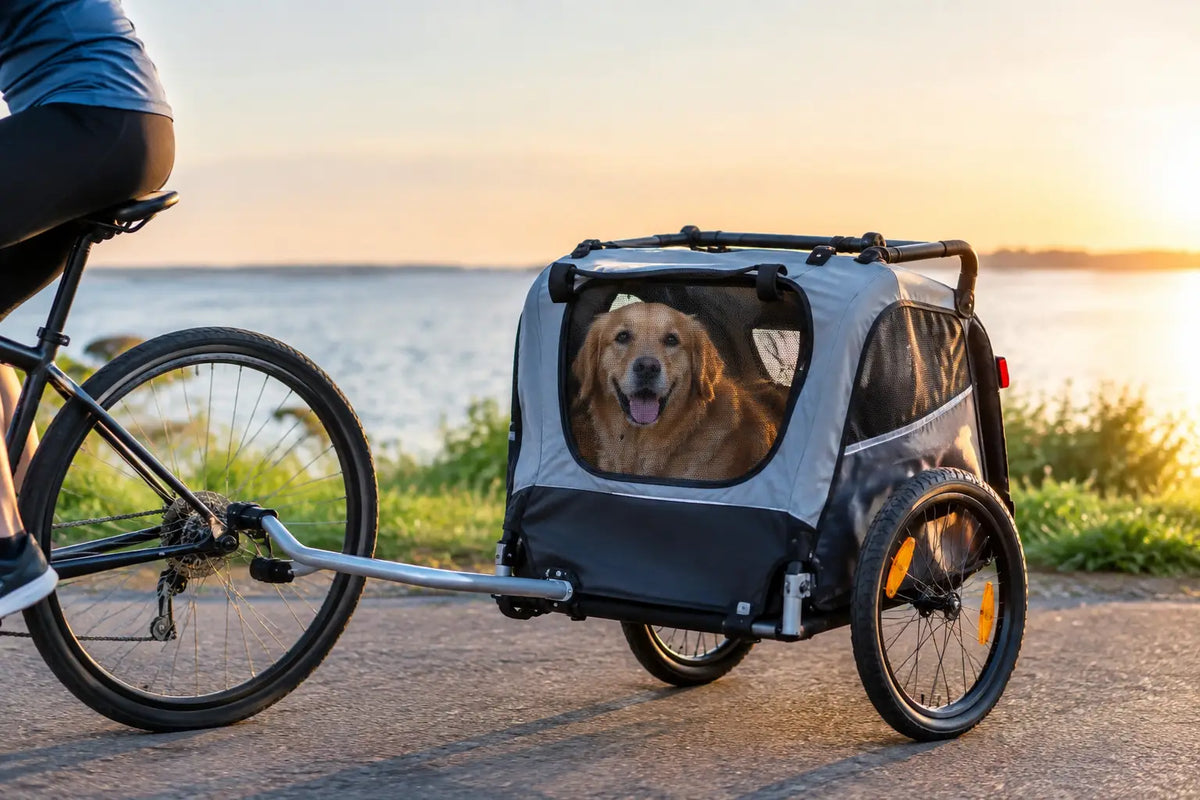
Small, hard wheels suit smooth indoor floors, shopping precincts and short town routes. They tend to keep a stroller lighter and more compact, but may rattle over cracked pavements, kerbs and gravel. If your regular walk includes canal paths, woodland tracks or uneven park ground, larger air-filled or puncture-resistant tyres and a suspension system can make a striking difference to your dog's comfort.
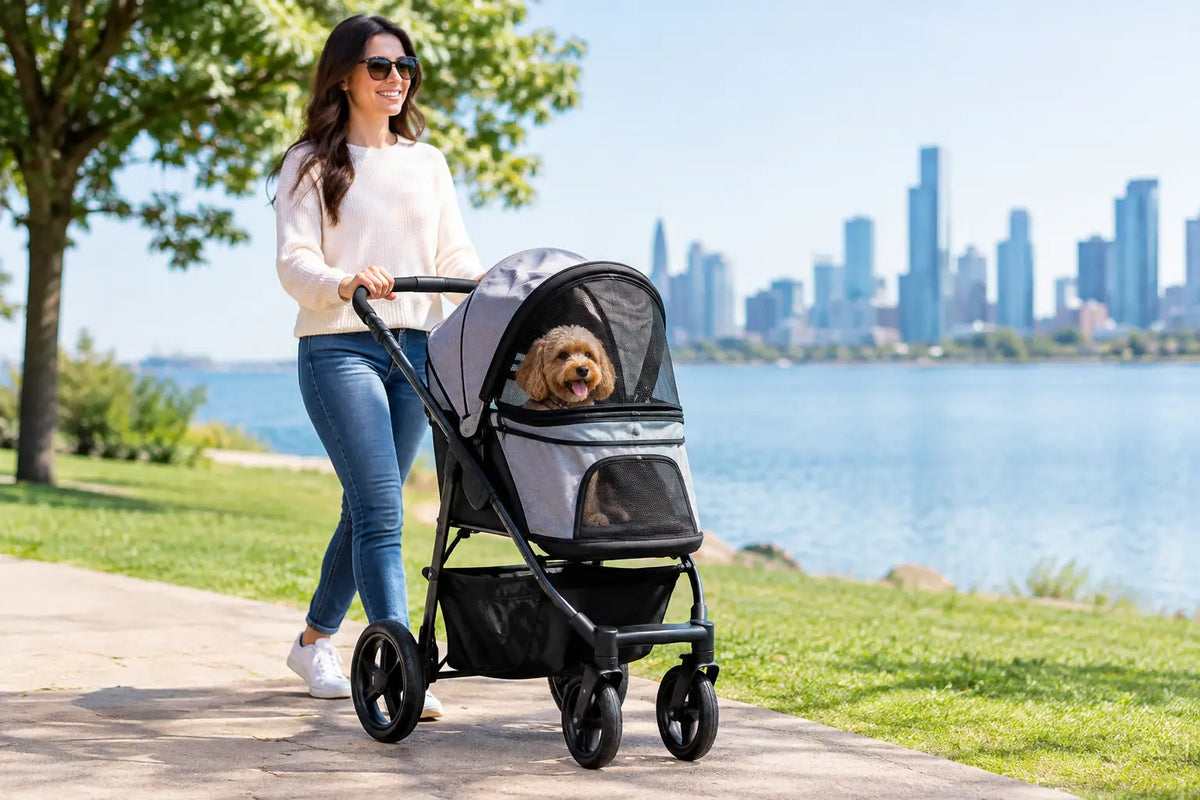
Three-wheel strollers are often easier to steer one-handed and cope well with longer outdoor routes. Four-wheel designs can feel more planted at low speeds and are often convenient in cafés, shops and narrow pavements. Neither layout is automatically better. Consider the surface, the weight of your pet and where the stroller will be stored.
A front wheel that swivels is useful for manoeuvring around tables and through tight spaces. The ability to lock it straight is valuable on rougher ground, where a freely swivelling wheel can wobble or pull. Test the brakes, too. Rear parking brakes should engage clearly and hold the stroller securely on a slope. Do not assume the brake is suitable for running or downhill control unless the manufacturer explicitly says so.
Handle height deserves attention if more than one person will push. A comfortable, adjustable handle reduces wrist strain and makes longer outings more enjoyable. This may sound like an owner-focused detail, but an awkward stroller is less likely to be used, and your dog deserves a seat on the adventure too.
Fold, lift and fit it into real life
Before choosing a stroller, picture the full journey. Will it need to fit behind the front seats of a small car? Can you lift it over a doorstep while holding a lead? Is there room to store it unfolded at home? A substantial all-terrain stroller often delivers a smoother ride, but it may be heavier and take up more boot space than a lightweight city model.
Check the folded dimensions and folded weight, not just claims such as “compact fold”. A quick folding mechanism is helpful after a muddy walk or when boarding public transport, but only if it locks closed safely and does not require you to remove several parts first. Storage baskets are handy for water, treats, medication and a rain cover, although overloading them can make the stroller unstable.
If you intend to use buses, trains or busy town centres, be realistic about your pet's size and the stroller's footprint. A stroller that is perfect for open parkland may be cumbersome in a narrow aisle. In the UK, access policies vary between operators and venues, so checking ahead can save an awkward change of plan.
Safety checks worth making before every outing
Premium construction is valuable because a stroller carries a live passenger, but it still needs routine checks. Before leaving home, make sure the frame is fully opened and locked, tyres are sound, brakes work and all zips, clips and tethers are secure. Confirm that your pet is within the stated weight limit, including blankets or essentials carried inside the cabin.
Take the first few walks slowly. Let your dog investigate the stroller at home with treats and the canopy open. Encourage them to step in if the design allows, then build up to short, calm rides. Pushing straight over kerbs, rather than approaching at an angle, helps reduce jolts. Lift the front where appropriate instead of forcing a loaded stroller up a high kerb.
Be aware of the situations a stroller cannot solve. It will not make a nervous dog comfortable in a noisy crowd, nor should it be used to keep a dog outdoors beyond their temperature tolerance. A dog panting heavily, trying to climb out or repeatedly shifting position may need a quieter route, water, shade or simply to go home.
Which type of stroller is right for you?
A lightweight urban stroller is usually best for small pets, pavements, errands and occasional public transport. An all-terrain model earns its place for families who spend weekends on uneven paths or cover longer distances, provided they have space for its larger frame. A low-entry or roomy cabin design is often the kindest option for older, injured or mobility-limited dogs, where easy access and stable support matter more than minimum weight.
For multi-pet households, resist the temptation to judge capacity by total kilograms alone. Two dogs can move around independently, changing the stroller's balance. They also need enough room to settle without crowding each other. A larger cabin and carefully positioned tethers are safer than squeezing two pets into a model designed for one.
At Pets Own Us, we believe mobility equipment should help pets keep their place in the family, whether that means a gentle stroll to the café or a proper day exploring together. Choose the stroller that respects your dog's body, your usual routes and the way you want to live together. When the ride feels calm and comfortable, the destination can be as ordinary as the corner shop and still feel like a shared adventure.