How to Measure a Dog Wheelchair for the Right Fit
A wheelchair should help your dog reclaim the things that make them feel like themselves: sniffing the hedge, joining the school-run walk, pottering around the garden, or keeping up on a family day out. Knowing how to measure a dog wheelchair properly is what turns a mobility aid from a well-meant purchase into comfortable, confidence-building support.
The key is not simply choosing a cart by breed or weight. Dogs of the same breed can have very different body lengths, chest shapes and leg heights. A precise set of measurements, taken with your dog in the right position, gives you the best starting point for a safe fit.
Start with the right type of wheelchair
Before reaching for the tape measure, establish what kind of support your dog needs. Most canine wheelchairs are rear-support carts, designed for dogs whose back legs are weak, paralysed, recovering from surgery or affected by conditions such as IVDD, arthritis or degenerative myelopathy. These carts support the hindquarters while your dog walks using their front legs.
A full-support wheelchair is different. It provides help at both the front and rear and may be appropriate when all four limbs are affected. Measuring requirements can differ between brands and designs, so always use the sizing guide supplied for the specific wheelchair you are considering rather than assuming one set of dimensions applies to every model.
Your vet, physiotherapist or rehabilitation professional can help confirm whether a wheelchair is suitable at this stage. A cart can support mobility, but it does not replace diagnosis, pain management or a recovery plan.
How to measure a dog wheelchair accurately
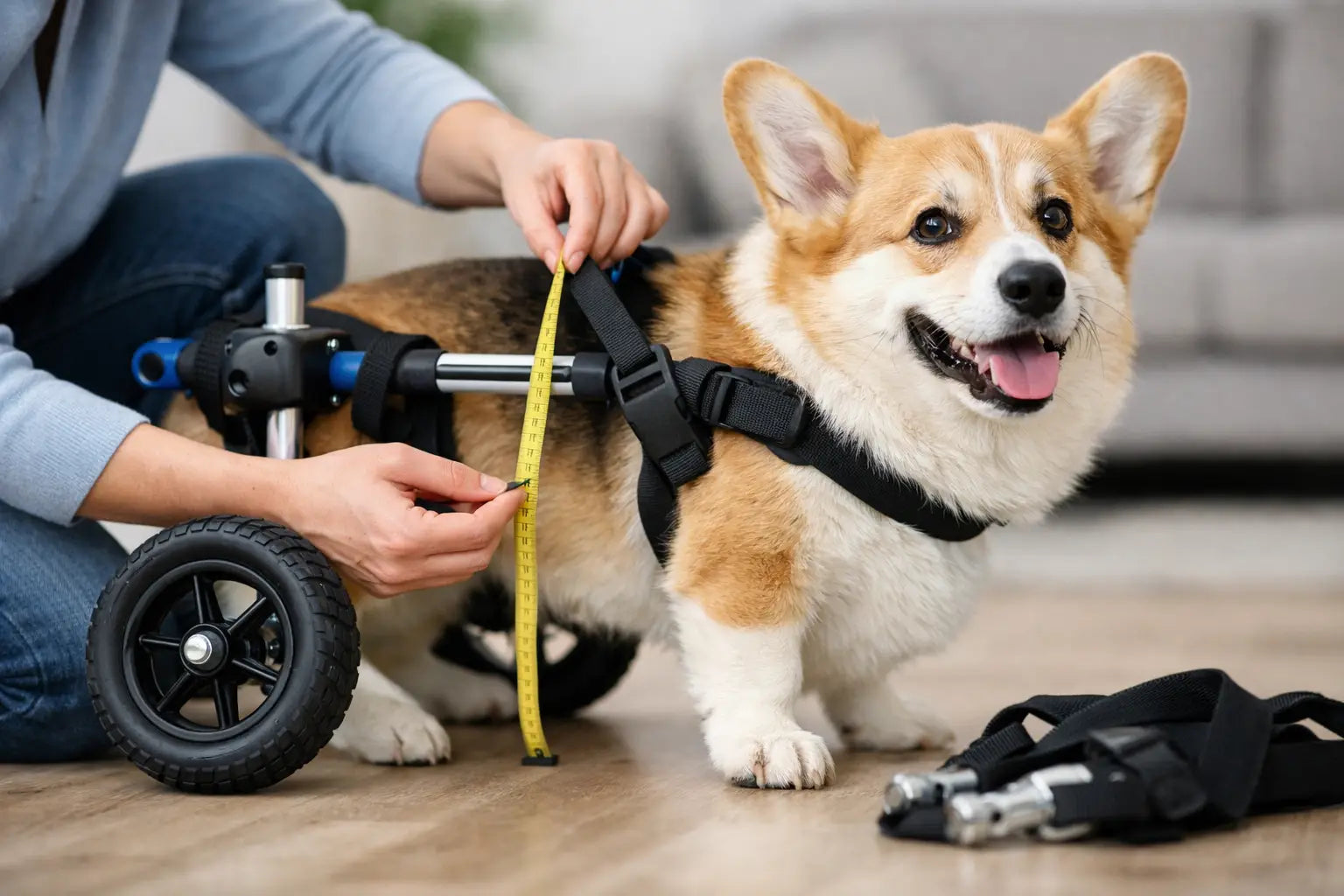
Use a flexible fabric tape measure rather than a rigid DIY tape. Have your dog stand naturally on a non-slip, level surface, ideally with another person nearby to offer calm reassurance and a treat. If your dog cannot stand unsupported, gently support them in a natural standing position without lifting their body too high or pulling their legs into an unusual position.
Measure in centimetres, write every figure down immediately, and take each measurement twice. If the two results differ, measure a third time and use the most consistent result. Do not add extra room “just in case”. Premium mobility equipment is usually adjustable in key areas, but starting with inflated measurements can leave the frame unstable or the harness rubbing.
Rear leg height
For a rear wheelchair, this is often the most important measurement. Measure from the ground to the point where your dog’s hind leg meets their body, near the top of the thigh. Depending on the manufacturer, this may be described as rear leg height, knuckle-to-groin measurement, or floor-to-hip height.
Follow the product instructions carefully because some brands ask for the measurement to the groin, while others specify the hip joint. Your dog should be standing squarely, with their back level and rear paws positioned as naturally as possible. Measuring while they are sitting, slouching or leaning can produce a cart that holds their back end too high or too low.
The aim is a neutral posture. Their spine should remain level rather than dipping towards the front or arching upwards at the rear. Their front legs should not have to strain to compensate for an incorrectly set frame height.
Body length
Measure from the front of the chest or shoulder area to the base of the tail, as directed by the wheelchair’s sizing chart. This measurement helps determine the frame length and where the support saddle will sit.
A frame that is too short can crowd the ribs and pull the rear support forward. One that is too long can shift behind the body, making steering awkward and placing pressure where it does not belong. Short-backed breeds, long-bodied dogs and dogs with a deep chest are especially worth measuring with care rather than relying on a general size label.
Hip width
Measure across the widest part of your dog’s hips, usually from one outer hip point to the other. Keep the tape straight and light against the coat rather than pulling it tight.
Hip width affects the spacing of the wheel frame and the way the saddle sits around the hindquarters. Too narrow, and the frame may press against the legs or hips. Too wide, and the cart can feel loose, wobble during turns and make it harder for your dog to walk efficiently.
Chest girth and chest width
Many wheelchairs use a chest harness to keep the cart securely aligned with your dog’s body. Measure the girth around the deepest part of the ribcage, usually just behind the front legs. If requested, also measure chest width across the front of the chest.
The harness should sit snugly enough to prevent slipping, yet allow normal breathing and shoulder movement. This is particularly relevant for broad-chested breeds and dogs with a barrel-shaped ribcage, where a standard harness can sit differently than expected.
Weight and condition
Record your dog’s current weight, even if the wheelchair is primarily sized by measurements. Weight limits are about more than whether the frame can carry your dog. They influence wheel choice, frame strength and how responsive the cart feels in use.
Be honest about body condition too. A dog recovering from surgery may gain or lose weight over the coming weeks, while a senior dog with muscle loss may need careful harness adjustment. If your dog falls near the edge of a size range, speak to a mobility specialist before ordering rather than guessing between sizes.
Measure with your dog’s real needs in mind
A wheelchair is not fitted in a vacuum. Think about where your dog will use it. Smooth pavements and indoor floors call for different wheel performance from muddy woodland paths, gravel tracks or uneven parkland. Larger wheels can make outdoor obstacles easier to manage, but the frame must still be correctly sized before terrain becomes the deciding factor.
Also consider whether your dog can toilet while supported by a rear cart. Many designs are made to allow this, but the saddle position and body length matter. Your dog deserves movement with dignity, not a setup that leaves them uncomfortable or restricts a normal daily routine.
If rear legs have some function, ask whether the cart can accommodate paw contact or stirrups. Some dogs benefit from placing their paws on the ground as they rebuild strength under professional guidance. Others need their paws safely lifted to avoid dragging and skin damage. The right approach depends on diagnosis, comfort and veterinary advice.
Check the fit once the wheelchair arrives
The first fitting should be calm and brief. Let your dog sniff the wheelchair before putting it on, and reward them generously. Start indoors or on a flat, quiet surface, with no pressure to achieve a long walk immediately.
Once fitted, check that the spine is level, the wheels sit parallel to the body, and the frame does not knock against the shoulders, ribs or hips. Your dog should be able to take natural forward steps with their front legs. Watch for leaning, hopping, twisting, scuffing, reluctance to move, laboured breathing or a harness that creeps towards the throat.
After the first few short sessions, inspect the skin under the harness and saddle for redness, hair loss or soreness. A little uncertainty is normal when a dog is learning a new sensation. Persistent discomfort is not. Stop, reassess the adjustment and seek professional help if you are unsure.
Common measuring mistakes to avoid
The most frequent error is measuring a lying or sitting dog because it is easier. It is understandable, especially when mobility is limited, but a lying measurement rarely reflects how the body aligns during supported walking. Supporting your dog gently in a standing position gives a far more useful result.
Another mistake is measuring over a thick winter coat, jumper or bulky harness. Take measurements against the body or over a very light layer, unless the manufacturer specifically says otherwise. Likewise, do not pull the tape tight enough to compress fur and soft tissue, or leave it so loose that the figure becomes meaningless.
Finally, do not assume a dog will “grow into” a wheelchair. For puppies, changing weight and limb length may make a highly adjustable design worthwhile, but they still need a fit that is safe now. For adult dogs, a wheelchair that is too large is not a comfort upgrade.
A well-measured wheelchair can make the difference between watching life from the sidelines and being part of it again. Take your time, follow the individual sizing guidance, and let every first roll be a gentle reminder that your dog still deserves a seat on the adventure too.