Measuring Dog Stroller Size for a Better Fit
A stroller that looks generously sized online can feel very different once your dog is inside it. There needs to be room to settle, turn and lie down without sliding about, while the overall frame still needs to suit your walks, car boot and storage space. Measuring dog stroller size properly before you buy helps make every outing more comfortable - especially for senior dogs, dogs recovering from surgery, and small companions who deserve a seat on the adventure too.
What size dog stroller does your dog need?
The right size is not simply the stroller with the highest weight limit. Weight capacity matters for the strength and stability of the chassis, but your dog’s body dimensions determine whether the cabin is genuinely comfortable.
A dog should be able to enter without being squeezed through the opening, stand in a natural posture, turn around, and lie down in their preferred sleeping position. Some dogs curl up tightly; others stretch from nose to tail and need a noticeably longer cabin. A long, lean Whippet and a compact French Bulldog may weigh much the same, yet need very different internal proportions.
Start with the stroller’s internal cabin dimensions, not its overall dimensions. Product measurements may show the pram’s full length, width and height including wheels, handlebars and canopy. Those figures are useful for your hallway or car, but they do not tell you how much usable room your dog has.
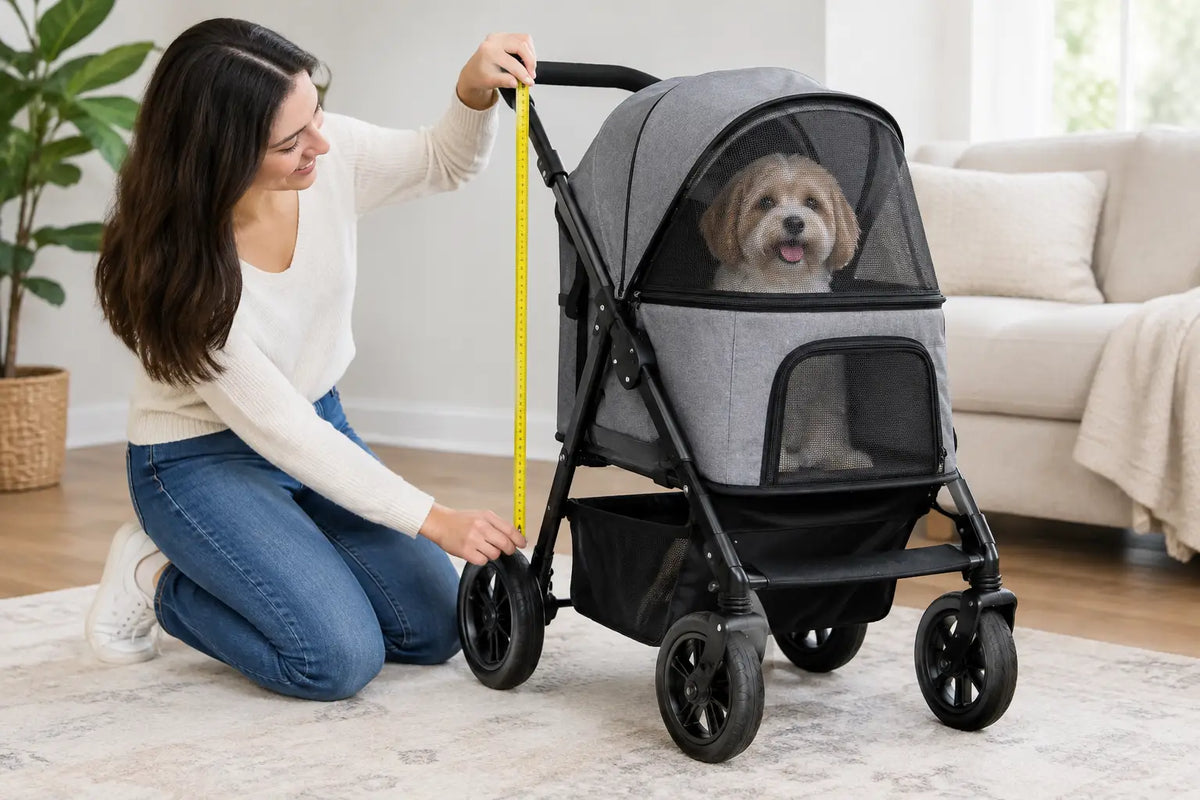
Measuring dog stroller size at home
Choose a calm moment and use a soft tape measure. If your dog is wriggly, a second person, a few treats and a quick measurement are usually more successful than trying to achieve millimetre-perfect results.
Measure their length when lying down
Ask your dog to lie in their usual relaxed position. Measure from the tip of the nose to the base of the tail, rather than to the tail tip. This is the most useful measurement for assessing cabin length.
Add a little breathing room. Around 5-10 cm is often sensible for a dog that curls up, while a dog that sleeps flat on their side may need more. Do not choose a stroller that matches their exact body length: that leaves no room to shift position during a longer walk.
Measure shoulder height when standing
Measure from the floor to the top of your dog’s shoulders, known as the withers. Compare this with the cabin’s internal height and, where relevant, the height of its entrance.
Your dog does not need to stand fully upright under a closed canopy at all times. However, a low roof can feel restrictive for a dog who likes to sit up and look out, while a high-sided cabin may make independent entry difficult for an older dog with weak joints. Check whether the canopy folds back, whether the front opens, and how high the step-in point is.
Measure the widest point
Measure across your dog’s shoulders or hips, depending on which is wider. This helps you judge the cabin width. Add enough space for them to turn around without brushing the sides constantly, but avoid excessive empty space for a small dog. In a very wide cabin, a lightweight dog can slide around on uneven pavements unless there is a supportive, well-fitted cushion or liner.
Weigh your dog accurately
Use your latest vet-recorded weight where possible, or weigh yourself, then weigh yourself while holding your dog and subtract the difference. Compare the result with the manufacturer’s stated maximum load.
Leave a margin rather than buying at the absolute limit. The load rating may include bedding, a rain cover, a water bottle or essentials stored in the cabin. More importantly, a stroller used continually at its maximum capacity can be harder to push and less stable over kerbs. If your dog is between sizes, the larger chassis is usually the safer choice, provided the cabin is not so roomy that they cannot feel settled.
Match the cabin shape to your dog’s needs
Dimensions tell only part of the story. A rectangular cabin gives a long-bodied dog useful stretching room, while a more rounded or compact shape may suit a small dog who prefers to curl up. Look at where the wheel arches sit too. External width can be generous, but wheel housings can reduce internal floor space.
For a dog with IVDD, arthritis, a spinal condition or post-operative restrictions, prioritise a flat, supportive base. They may need to remain in one position for much of the outing, so the usable lying area matters more than headroom. A firm mattress, or one that can accommodate their own vet-approved bedding, can make a significant difference to comfort.
Dogs with limited mobility also benefit from low, wide access. A stroller that is technically large enough but requires them to be lifted over a tall edge may still be right if you can lift them safely. If you cannot, an opening front panel or low-entry design can protect both your dog’s dignity and your back.
Do not overlook the stroller itself
Once the cabin fits your passenger, measure the practical spaces around your life. Check the stroller’s folded dimensions against your car boot, cupboard, porch or under-stairs storage. If you use public transport or live in a flat, overall width and folded weight can be as important as interior room.
Think about where you walk. Large wheels and a longer wheelbase are often more comfortable and stable over park paths, gravel and dropped kerbs, but they can feel cumbersome in narrow cafés or busy high streets. A compact city stroller may be easier to manoeuvre, although it may offer less suspension and a smaller cabin.
Handlebar height deserves attention too. A stroller that is too low can make regular walks uncomfortable for a taller owner; one that is too high may be awkward on slopes. If more than one person will use it, an adjustable handle is worth considering.
Sizing for two small dogs
Sharing can work well when two dogs already settle together calmly, but do not add their weights and assume any double-sized stroller will be comfortable. Measure each dog lying down and consider their combined width when seated side by side.
A shared cabin should allow both dogs to reposition without climbing over one another. It also needs separate attachment points, so each harness can be secured independently. A single tether clipped to two dogs is not safe: it can tangle and gives you less control if one dog suddenly moves.
For dogs with different temperaments or mobility needs, separate compartments or separate strollers may be kinder. The goal is peaceful inclusion, not simply fitting everyone into one space.
Check fit when the stroller arrives
Before heading out for a long walk, assemble the stroller indoors and let your dog investigate it at their own pace. Place familiar bedding inside, leave the canopy open and reward calm curiosity. Never force a worried dog into a new cabin.
Once they are comfortable, check the fit with them inside. The safety tether should attach to a harness, never a collar, and should be short enough to prevent jumping out while still allowing them to sit, turn and lie down. Make sure the canopy closes without touching their head or ears, and test that the brakes hold securely before loading or unloading.
Take a short first outing on smooth ground. Watch for signs that the cabin is too small, such as repeated repositioning, hunched sitting or reluctance to enter. Signs of too much unsecured space include sliding, bracing with their legs or being thrown off balance over minor bumps. A non-slip liner and correctly placed bedding can refine the fit, but they cannot compensate for the wrong cabin size.
A comfortable fit keeps adventures possible
The best dog stroller is not the biggest one or the lightest one. It is the one that gives your dog a stable, comfortable place to rest while fitting naturally into the way your family gets out and about. Take the measurements, allow a sensible margin, and choose for your dog’s body and needs rather than their breed label alone. A well-fitted stroller can turn a shorter walk, a recovery period or a tired pair of legs into another chance to be part of the day.