How to Crate Train Cats Safely for Travel
The carrier only appears when something unpleasant is about to happen: a vet appointment, a car journey or a stay away from home. It is no surprise that many cats vanish beneath the bed at the first rattle of its door. Learning how to crate train cats changes that association gradually. The aim is not to make a cat enjoy confinement, but to give them a familiar, secure space that makes necessary travel safer and less frightening.
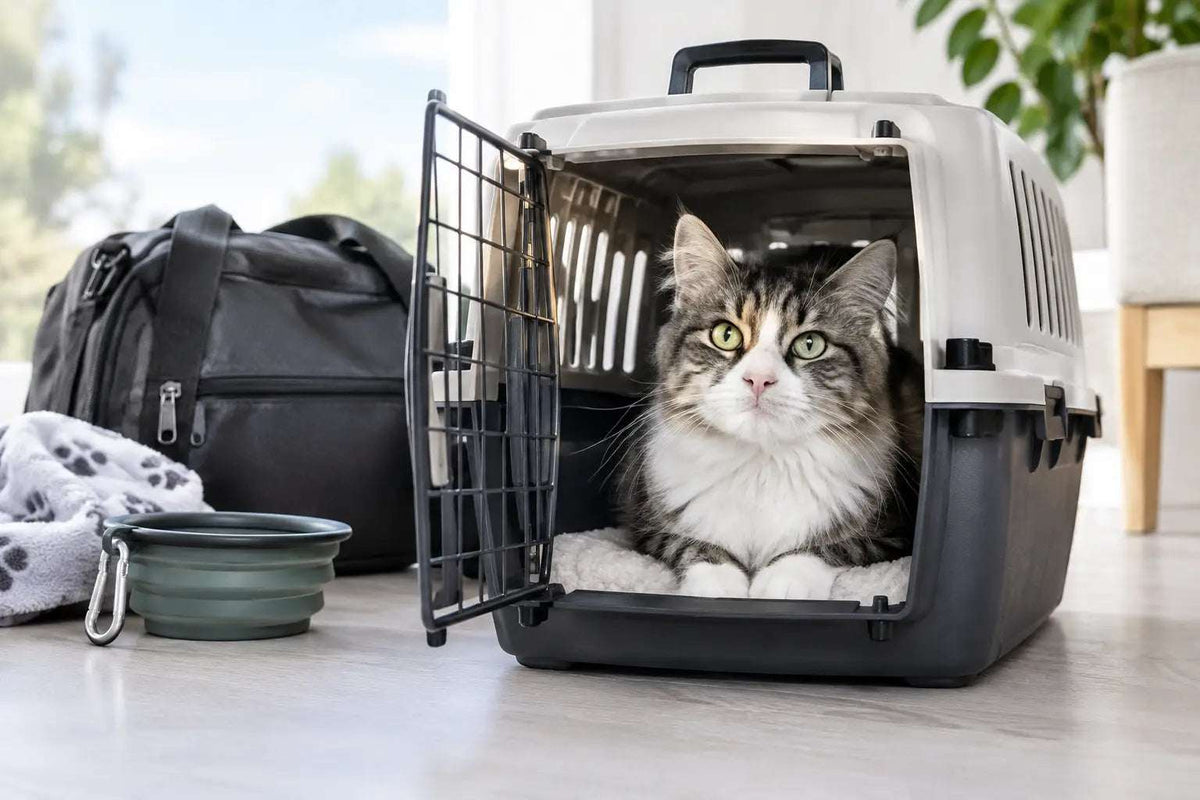
For most cats, a well-chosen travel carrier is the better term than a crate. It should be large enough for your cat to stand, turn around and lie comfortably, while remaining stable and manageable to carry. For car travel, the carrier also needs to be secured so it cannot slide, tip or become a projectile under sudden braking. Comfort and protection belong together.
Start by choosing a carrier your cat can live with
A carrier that is too small, flimsy or difficult to clean makes training harder before it has begun. Look for firm sides, good ventilation, a reliable fastening and an opening that allows calm, low-fuss access. A top-opening carrier can be useful for cats who dislike being pushed through a front door, while a model with a removable top can make veterinary examinations less stressful because your cat may not need to be pulled out at all.
Size matters, but bigger is not always better. A very spacious carrier can leave a cat feeling unstable during a journey, especially in the car. Your cat should have room to change position and settle naturally, with enough floor space for a familiar blanket or absorbent liner. Check the manufacturer’s weight guidance, then consider your individual cat’s length, build and confidence level.
For a kitten, choose a carrier that will remain practical as they grow, but avoid creating too much empty space. For a senior cat, a cat recovering from surgery, or one with arthritis or limited mobility, a low entry and supportive, non-slip bedding can make a meaningful difference. Dignity matters when getting in and out is no longer effortless.
How to crate train cats: make it part of home life
The fastest way to create carrier anxiety is to store it in a cupboard for months, then bring it out only for a stressful event. Instead, leave it open in a quiet area where your cat already feels at ease. Place a soft blanket that smells of home inside, ideally one they have used before. Keep the door secured open so there is no risk of it swinging shut and startling them.
At first, do nothing more. Let your cat inspect it on their own terms. Some will walk in immediately; others may take several days just to sniff around it. Both responses are normal. Never place a reluctant cat inside to ‘show them’ it is safe. A carrier becomes reassuring through choice and repeated good experiences, not persuasion.
Once your cat is comfortable approaching it, begin leaving a few high-value treats just inside the entrance. Then place them farther back as confidence grows. You can offer part of a favourite meal nearby, then just inside the carrier, provided your cat is relaxed enough to eat. Quiet praise is fine, but keep the moment low-key. Many cats find a calm room and predictable routine more rewarding than enthusiastic attention.
A familiar scent can be especially powerful. Add their usual bedding or a soft T-shirt that smells like you, but avoid loose items that could tangle around them. If your cat responds well to a feline pheromone spray, use it on the carrier bedding in advance and allow it to dry completely. It should support training, not replace it.
Build comfort in tiny stages
When your cat is choosing to sit or rest inside, practise briefly closing the door. Start with one or two seconds, give a treat through the door, then open it before they show concern. Repeat on another occasion rather than extending the session too quickly.
Increase the time in small, uneventful steps: ten seconds, half a minute, a minute, then a few minutes. Stay nearby initially. If your cat is calm, you can sit beside the carrier, read or carry on with a quiet task. The lesson is simple: the door can close, and nothing bad follows.
Watch your cat rather than the clock. A cat who settles, blinks slowly, takes treats or lies down is coping. Persistent yowling, frantic scratching, panting, drooling, wide eyes or repeated attempts to escape mean the step was too difficult. Open the door calmly, make the next session easier, and slow the pace. Punishment, shouting or tapping the carrier only confirms that it is a place to fear.
Add movement before you add a journey
Being enclosed is only one part of travel. The lifting, carrying and motion are often what unsettle cats most. Once your cat can rest comfortably with the door closed, lift the carrier for a few seconds and set it down gently. Reward calm behaviour, then finish.
Progress to carrying it around one room, then through the house. Keep the base level and support it from underneath rather than swinging it by a handle. If the carrier has a shoulder strap, check that it is designed for your cat’s weight and that all clips are properly fastened. Your cat deserves a steady ride, not a bumpy one.
Next, introduce the car without going anywhere. Secure the carrier in its intended position, sit with your cat for a minute or two, then return indoors. Once this is unremarkable, try a very short drive and come straight home. Gradually lengthen journeys over several sessions.
Never allow a cat to travel loose in a vehicle. They can distract the driver, slip under pedals or bolt through an open door after arrival. A secure carrier should be restrained according to its design and your vehicle’s layout, using the vehicle seat belt or compatible anchoring points where specified. Avoid the front passenger seat where an active airbag presents a risk. A covered carrier can reduce visual stimulation for some cats, but maintain ventilation and never allow the cover to block airflow.
Keep travel calm, clean and predictable
For routine vet visits, aim to leave enough time that you are not rushing your cat into the carrier. A calm approach at home sets the tone for the whole journey. If your cat has hidden, do not chase them from room to room. Instead, make the carrier available well ahead of time and, where possible, keep them in a quiet room with it before you need to leave.
For longer journeys, line the carrier with an absorbent layer beneath their familiar blanket. Carry a spare liner and bedding in case of sickness or toileting accidents. Offer water at sensible breaks if your journey is extended, but do not open the carrier outside or in an unsecured vehicle. Even a normally relaxed cat can panic in an unfamiliar place.
Food requires judgement. Many cats travel better without a large meal immediately before departure, particularly if they are prone to nausea. For a planned trip, ask your vet for individual advice on feeding, motion sickness and anxiety. Sedation is not a casual solution and may be unsuitable for travel, especially where temperature, breathing and balance are concerns.
Air travel has its own rules. Airline-compliant carriers have specific dimensions and construction requirements, and these vary by airline, route and whether the cat travels in the cabin or hold. Check the current policy directly before buying or booking. A carrier that works brilliantly for car trips may not meet airline limits.
When crate training needs extra support
Some cats have a long history of difficult journeys, while others are naturally more anxious or have pain that makes handling hard. If training repeatedly causes panic, pause rather than pushing through. A vet can rule out illness, pain or travel sickness, and may suggest a tailored behaviour plan. A qualified feline behaviourist can also help where fear is entrenched.
This is particularly worthwhile for cats with mobility challenges, respiratory conditions or previous trauma. The goal is not perfect silence in a carrier. It is helping your cat feel as safe and supported as possible when life requires them to travel.
Keep the carrier out after the appointment or holiday is over. Let it return to being a bed, a hiding place and a normal part of the furniture. With patient practice, that once-dreaded box can become one small, familiar piece of the adventures you share together.