Best Airline Carriers for Cats for Calm Flights
A carrier can look perfectly roomy in your kitchen and still be refused at the airport gate. When choosing the best airline carriers for cats, the detail that matters most is not the colour or even the label on the packaging. It is whether the carrier fits your specific airline’s under-seat allowance while giving your cat enough structure, airflow and reassurance for a long, unfamiliar day.
For cats, travelling well is usually about feeling safely contained rather than having maximum open space. The right carrier creates a quiet, den-like place they cannot escape from, can breathe comfortably in and can be handled without collapsing or tipping. That is what makes a carrier genuinely fit for flight, rather than merely convenient for a trip to the vet.
What the best airline carriers for cats have in common
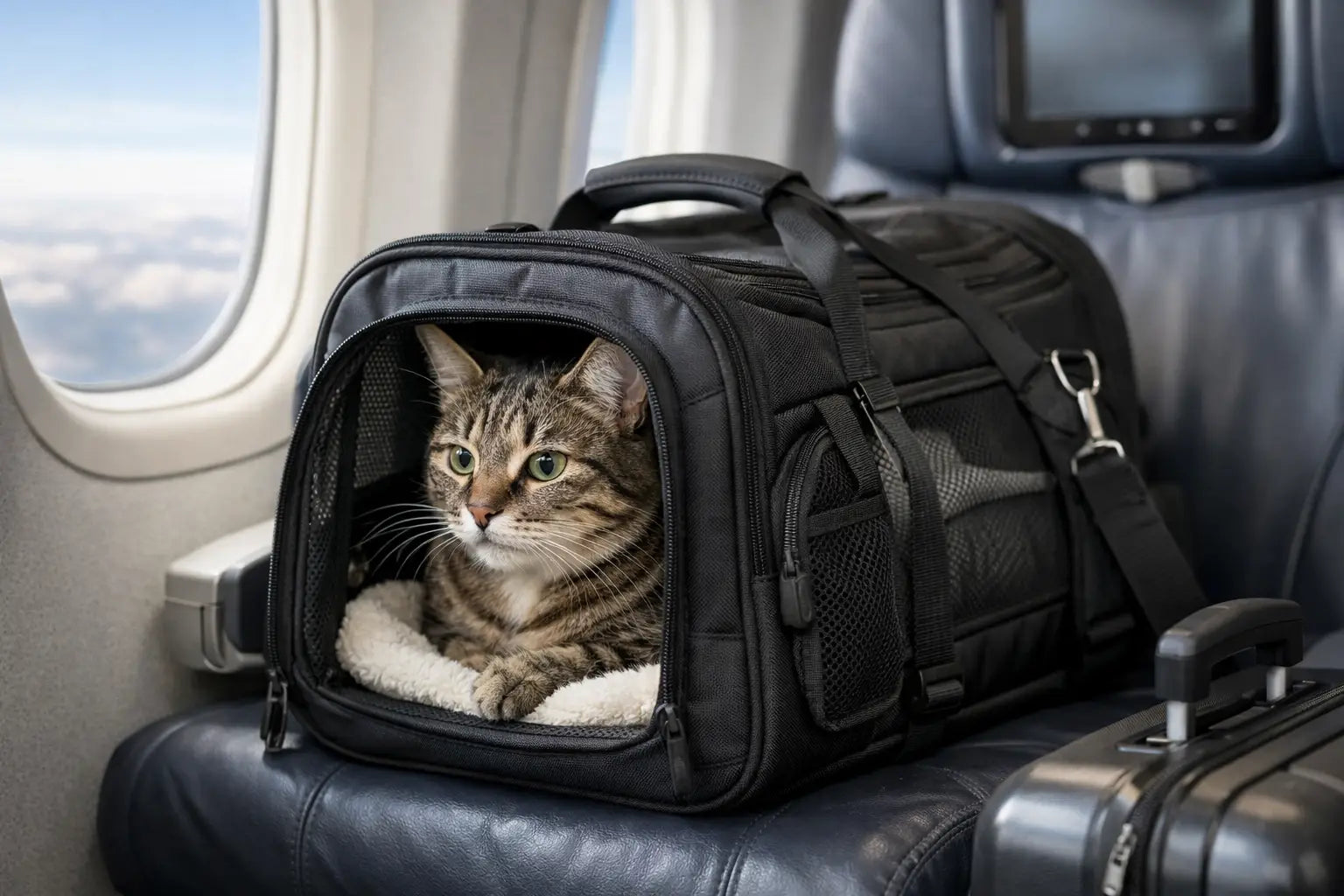
The strongest choice for most cats travelling in the cabin is a high-quality soft-sided carrier with a firm, supportive base. Soft sides can flex slightly beneath an aircraft seat, which is useful because airline measurements are often unforgiving. A rigid plastic carrier may be durable, but it is more likely to exceed cabin dimensions even when it appears compact.
That flexibility must not mean flimsiness. Look for reinforced panels that hold their shape, a base that does not sag under your cat’s weight, and zips that cannot be pushed open by an anxious paw. A carrier should stay level when lifted. If it folds around your cat or swings heavily from one side, it will feel unstable at precisely the moment they need to feel secure.
Ventilation is equally central. Mesh panels on more than one side help air move through the carrier, particularly during check-in, security and boarding queues. They also allow you to check on your cat without repeatedly opening the carrier. A privacy flap can be a thoughtful addition for cats who settle better when visual stimulation is reduced, provided it does not restrict ventilation.
Choose a model with access from the top as well as the side where possible. A top opening makes it far easier to place a reluctant cat inside calmly, rather than trying to guide them through a narrow front door. It also gives you a controlled way to offer reassurance or adjust bedding once you are seated.
Start with the airline, not the carrier
There is no universal definition of an airline-approved cat carrier. Every airline sets its own rules, and those rules can differ between cabin travel, hold travel, aircraft types and routes. A carrier described as airline-compliant is a useful starting point, not a guarantee of acceptance.
Before buying, check your airline’s current requirements for the exact flight you are taking. Focus on the maximum external length, width and height, whether dimensions include handles and wheels, the combined pet-and-carrier weight limit, and whether cats are permitted in the cabin on that route. Some airlines do not carry pets in the cabin at all, while others limit the number of animals allowed on each flight, so booking your cat’s place early matters.
Measure the carrier when it is packed as it will be on the day. A thick bed, a full water bowl or an overstuffed side pocket can change its shape and make it harder to slide below the seat. Keep exterior pockets slim and use them only for essentials such as paperwork, a small pack of wipes and a spare absorbent pad.
For a cabin journey, your cat must normally remain in the carrier for the whole flight. Choose a size that lets them stand, turn around and lie down naturally, but do not assume bigger is always kinder. A carrier that is too large for the under-seat space may be rejected, and excessive room can make a cat feel less stable during movement.
Soft-sided, hard-sided or hold crate?
A soft-sided cabin carrier is usually the practical answer for a healthy cat travelling with you in the passenger cabin. It is lighter to carry, often more comfortable against your leg during a wait, and more likely to work with the low clearance beneath a seat. Premium versions add useful details: a washable base, locking zips, reinforced seams and luggage sleeve options for steadier movement through the terminal.
Hard-sided carriers have their place, especially for car travel and short journeys where impact protection and easy cleaning are priorities. For flying in the cabin, however, their fixed dimensions are a limitation. They can also be noisier when set down and less forgiving if your cat shifts their weight.
If an airline requires your cat to travel in the hold, the specification changes completely. You will need a purpose-built, IATA-compliant travel crate accepted by that airline, with rigid construction, secure ventilation, suitable fittings and a correctly sized interior. Hold travel deserves more planning and should never be treated as a simple extension of cabin travel. Speak to the airline directly, consider your cat’s temperament and health, and ask your vet for individual advice before committing to the journey.
Cats with breathing difficulties, heart conditions, severe travel anxiety or a history of panic in confinement may not be suitable candidates for air travel without professional guidance. Flat-faced breeds can need particular consideration because their airway anatomy may make heat and stress harder to manage.
Comfort is a safety feature
The carrier itself is only part of the setup. Line the base with an absorbent, non-slip pad, then add a familiar-smelling blanket or a thin piece of bedding. Avoid bulky cushions that take up valuable internal height or slide around when the carrier is lifted. For a cat who sprays or gets travel sick, pack a spare pad in a sealed bag so you can make a quick change if needed.
A secure harness and identification tag are sensible layers of protection, but do not rely on a harness instead of a properly closed carrier. Airport environments are noisy, busy and full of gaps a frightened cat can disappear through. Keep your cat contained unless staff explicitly instruct otherwise, and ask in advance how security screening is handled at your departure airport.
Do not introduce a new carrier on the morning of the flight. Leave it open at home for several weeks, add familiar bedding and occasionally place treats or meals inside. The aim is for your cat to see it as a predictable resting spot, not as the object that only appears before an ordeal. A few short, calm practice journeys in the car can also reveal whether the base stays stable and whether your cat prefers the privacy flap open or closed.
Sedation is not a casual solution to travel stress. It can affect balance, breathing and temperature regulation, and airlines may have their own restrictions. If you are worried about anxiety, ask your vet well before departure about options appropriate for your cat.
Details worth paying for
Premium carriers earn their place when their engineering reduces failure points. Double zips, internal safety clips, strong stitching and a rigid removable base are not decorative extras. They help prevent escapes, discomfort and a carrier becoming misshapen halfway through a terminal.
A washable lining is particularly valuable for frequent travellers, as is a water-resistant outer fabric that can cope with wet pavements between the taxi and the terminal. Choose a carrier with comfortable handles and, if you expect a long airport walk, an adjustable padded shoulder strap. The weight of the carrier matters too: every gram comes out of the airline’s pet-and-carrier allowance.
Be wary of carrier claims that focus only on breed. Two cats of the same breed can differ significantly in body length, shoulder height and confidence level. Measure your own cat while standing and lying down, then compare those measurements with the usable internal space, not merely the carrier’s external dimensions.
A calmer departure starts at home
Feed a light meal at a time that suits your vet’s guidance and your departure schedule, rather than offering a large meal immediately before leaving. Give your cat access to the litter tray before setting off, arrive with time to spare and keep your own movements measured. Cats are very good at noticing when the family’s energy has changed.
The best carrier is the one that meets the airline’s rules without asking your cat to compromise on dignity or comfort. Choose carefully, practise early and let the carrier become part of the adventure before the airport is ever in sight. Your cat deserves a safe place beside you, wherever the journey leads.