How to Choose a Small Animal Travel Carrier
A carrier is more than a way to get from the house to the vet. For a rabbit, guinea pig, ferret or other small companion, it is a temporary safe space during a journey they may not fully understand. The right small animal travel carrier helps prevent escapes, protects delicate bodies from bumps and draughts, and gives your pet enough familiar comfort to arrive feeling settled rather than overwhelmed.
For short appointments, a simple secure carrier may be ideal. For longer car journeys, train travel or holidays, ventilation, stability and ease of cleaning become just as important as size. Here is how to choose with your pet’s welfare, your journey and real-life practicality in mind.
Start with your animal, not the carrier style
Small animals have very different travel needs. A carrier that suits a guinea pig may be too low for a rabbit to sit naturally in, while a soft-sided bag that works for a calm ferret may not be a sensible choice for an animal prone to chewing or panic.
Your pet should be able to turn around comfortably and lie down in a natural position. For rabbits, enough internal height matters too. They should not need to flatten their ears or crouch for the entire journey. Bigger is not automatically better, however. An oversized carrier can leave a small animal sliding about when the car turns or brakes.
Consider whether your pet needs to travel with a bonded companion. Rabbits and guinea pigs often take reassurance from their established partner, and separating a bonded pair can create unnecessary stress. In that case, choose a carrier that gives both animals space without becoming so large that it is difficult to carry safely or secure in the car.
The carrier must also match your pet’s habits. Determined chewers, skilled escape artists and animals that scratch when anxious need strong materials, secure catches and well-designed ventilation openings. A carrier should never rely on a zip, flimsy clip or loose-fitting lid as its only point of security.
Choosing a small animal travel carrier by journey type
A carrier for a five-minute vet visit does not need to solve the same problems as one for a two-hour drive. Thinking about the journey first prevents a common mistake: buying a carrier that looks comfortable at home but is awkward, unstable or poorly ventilated once you are on the move.
Vet visits and short local trips
For routine appointments, prioritise a stable base, secure door and easy access. Top-opening carriers can make it easier to lift a small animal out without chasing them through a front door, which is particularly useful for nervous guinea pigs and rabbits.
A removable base or wide-opening design also makes cleaning simpler after an accident. Stress can affect digestion and toileting, so washable surfaces are practical, not a luxury. Add absorbent bedding beneath a familiar fleece or towel, but avoid loose layers that bunch up and make footing uncertain.
Car journeys and day trips
In a car, the carrier needs to stay level and protected from movement. Never place it loose on a seat, in a footwell where it may be knocked, or in a hot boot with restricted airflow. Position it on a flat surface and secure it according to the carrier and vehicle guidance, so it cannot slide or tip during braking.
Keep the cabin comfortably ventilated without directing cold air-conditioning or heat straight at your pet. Small animals can be sensitive to temperature changes, and rabbits in particular can struggle in warm conditions. On hot days, travel during cooler hours where possible, park in shade and never leave an animal unattended in a vehicle.
For longer trips, plan quiet stops to check your pet rather than repeatedly opening the carrier. A quick visual check, access to suitable hay and water arrangements appropriate for the animal and journey, plus a calm environment, are usually more reassuring than constant handling.
Public transport and holidays
If you are travelling by train, carrier weight becomes a serious consideration. A rigid carrier offers excellent protection, but it can be cumbersome when you are navigating platforms, gates and luggage. A lightweight design with a strong handle may be easier to manage, provided it remains escape-proof and keeps its shape when carried.
For flights, do not assume a carrier described as airline-compliant will be accepted by every airline or on every route. Cabin and hold requirements differ, including dimensions, construction, ventilation and which species are permitted. Check the airline’s current policy before booking, then measure the carrier externally rather than relying on its product description alone. For many small animals, road or rail travel may be the kinder option.
Materials, ventilation and cleaning matter more than colour
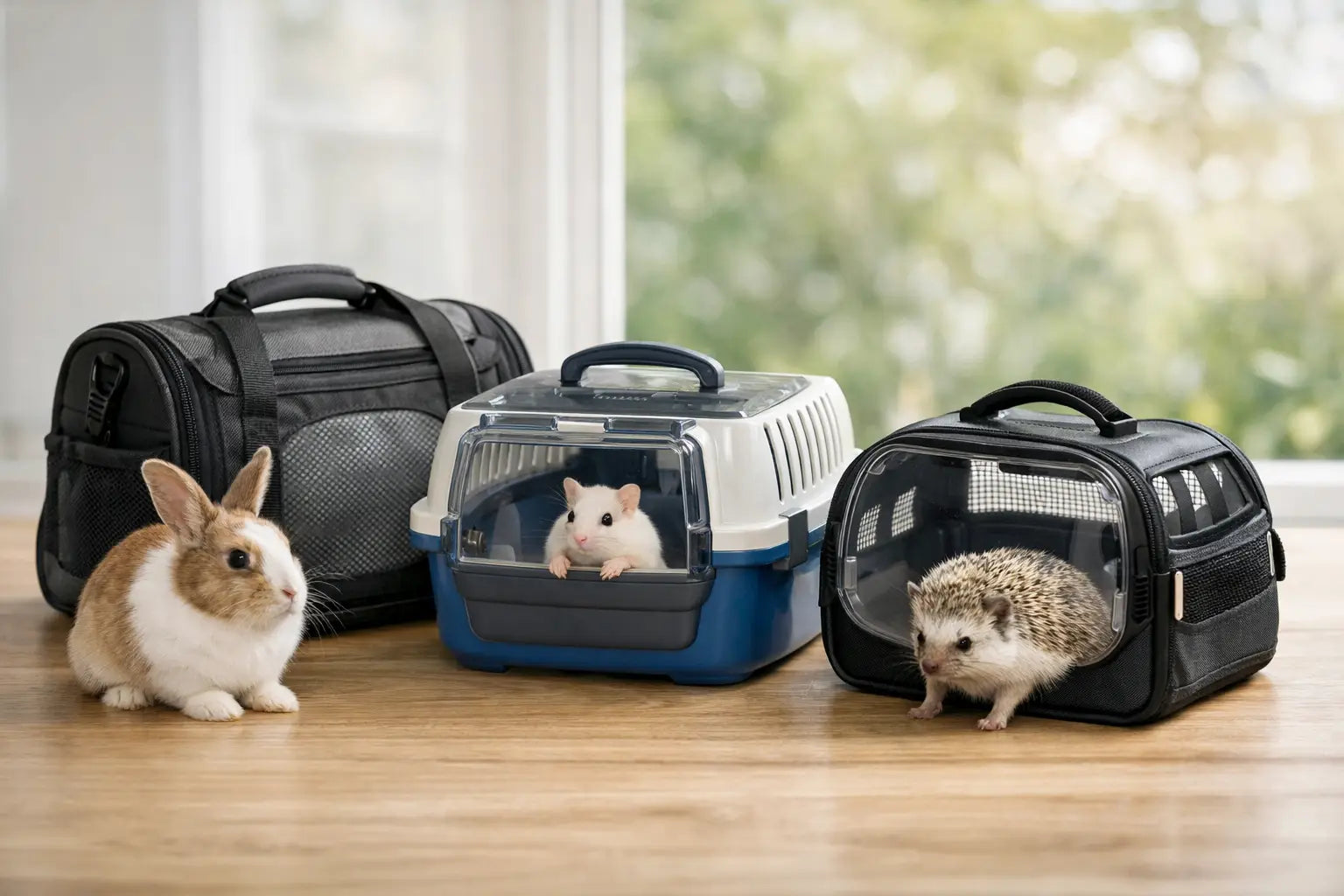
A premium carrier should make life easier for both you and your pet. Hard plastic carriers are often durable, easy to wipe clean and difficult to chew through. They tend to offer good protection for car travel, although they can be heavier. Metal doors provide reassurance when properly secured, but check that there are no sharp edges or gaps where tiny paws could catch.
Soft carriers are lighter and can feel less bulky for occasional transport, but they are not suitable for every animal. They need a firm, supportive base, mesh that cannot be easily damaged and reliable ventilation. If a rabbit or rodent is likely to chew fabric or mesh, a rigid carrier is generally the safer decision.
Ventilation should be generous but not so open that your pet is exposed to wind, rain or a busy visual environment from every angle. Some animals settle better with part of the carrier lightly covered using a breathable cloth, leaving airflow fully clear. This can reduce the movement and noise they see around them without making the carrier stuffy.
Look for a carrier with straightforward access for cleaning. Smooth interiors, removable sections and secure fastenings can save a great deal of stress after a muddy outing or an unexpected travel accident. Avoid heavily scented cleaners when washing it. Rinse thoroughly and allow it to dry completely before replacing familiar bedding.
Help your pet see the carrier as a safe place
The best carrier in the world can still feel frightening if it only appears before a vet appointment. Introduce it well before travel day by leaving it open in your pet’s usual space with bedding that smells familiar. Let them explore in their own time.
For rabbits and guinea pigs, place a little of their usual hay inside and allow calm, voluntary visits. Short practice sessions can help too: close the door briefly, lift the carrier gently, then put it back down and reward with a suitable favourite food. Build up slowly, especially with timid animals.
Keep the inside simple. Familiar bedding, hay where appropriate and a non-slip base are usually more useful than lots of new accessories. Avoid toys or bowls that could roll around during the journey. If you need water for a longer trip, choose a method your pet already understands and check it is not leaking before setting off.
A quick safety check before you leave
Before every journey, inspect the door, catches, handle and ventilation panels. Test that the carrier closes securely and that your pet cannot reach a gap, loose edge or damaged section. Check the base is dry and the bedding gives secure footing.
Bring a small travel kit for anything beyond a very short trip. Useful items include spare bedding, hay or species-appropriate food, wipes, a towel, a bag for soiled bedding and your vet’s contact details. If your animal is on medication, keep it accessible and follow your veterinary team’s advice on timing, feeding and travel.
Most importantly, allow extra time. Rushing makes handling less gentle and increases the chance of a missed latch or a carrier being placed unsafely. Your little companion may not be choosing the destination, but they still deserve a calm, secure seat on the adventure.