Dog Wheelchair Sizing Guide for a Better Fit
A wheelchair should help your dog feel like themselves again - able to sniff, explore and stay part of family life - not leave them dangling in an awkward frame. This dog wheelchair sizing guide explains the measurements that matter, how to check fit, and when a rear-support cart may not be enough.
Start with the right type of dog wheelchair
Sizing only works when the wheelchair design matches your dog's needs. A rear-support wheelchair is usually intended for dogs whose front legs remain strong and coordinated, but who need help because of hind-leg weakness, paralysis, post-operative recovery or age-related mobility changes. It supports the pelvis and allows the front legs to provide propulsion.
A quad or full-support wheelchair supports both front and rear limbs. It may suit a dog with weakness affecting all four legs, a progressive neurological condition, severe arthritis or reduced front-end strength. These carts are more complex to fit, because the dog must be supported without restricting shoulder movement, breathing or toileting.
There is a trade-off here. A lighter rear cart can feel less intrusive for a dog with good front-end strength, while a full-support design can provide essential stability but needs more careful adjustment. Your veterinary surgeon or veterinary physiotherapist should advise on the level of support needed, particularly after spinal surgery, with IVDD, or where pain and neurological signs are changing.
Dog wheelchair sizing guide: the key measurements
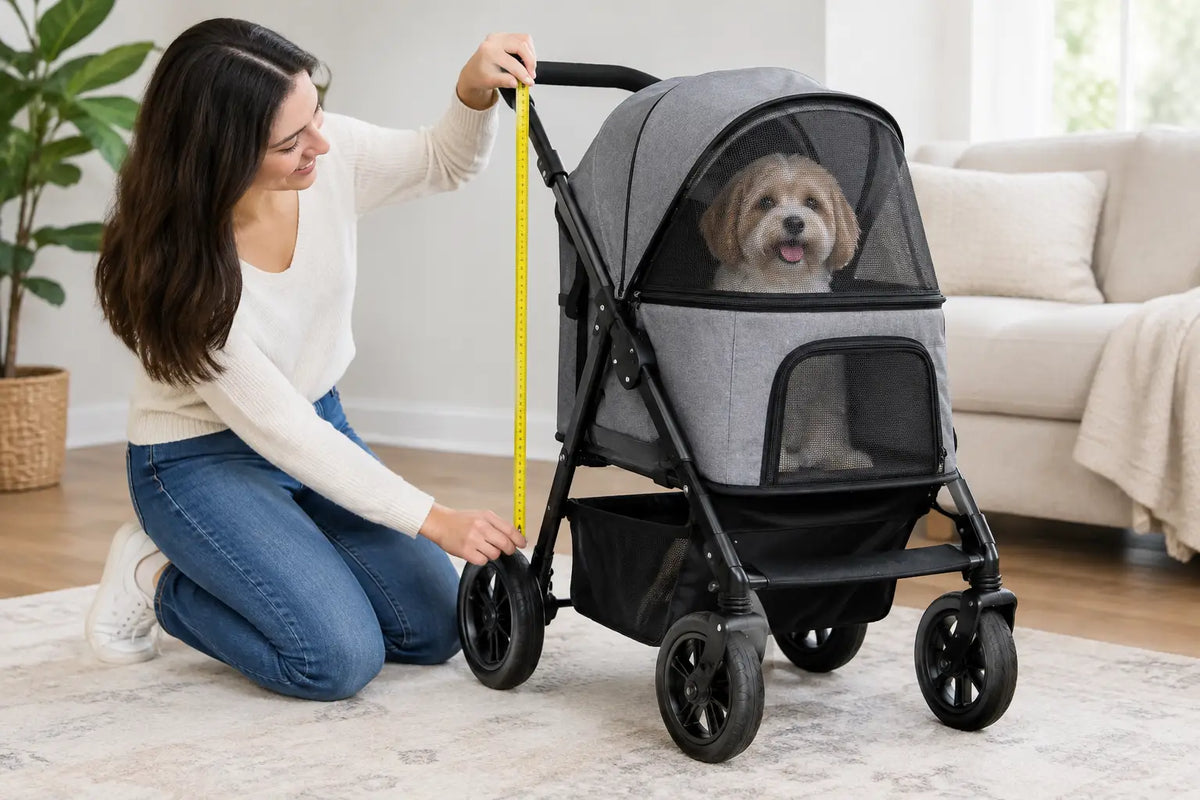
Every manufacturer has its own measuring instructions, so always use the guide supplied for the specific wheelchair you are considering. A small difference in where a measurement starts or ends can change the size recommended. Measure your dog standing squarely on a non-slip surface, ideally with another person calmly holding a treat at nose height.
Use a soft tape measure and record measurements in centimetres. Take each one twice. If your dog is between sizes, do not automatically size up: the right decision depends on the brand's adjustment range, your dog's body shape and whether they are still growing.
Rear leg height
For a rear wheelchair, this is often the most decisive measurement. It is commonly taken from the ground to the crease where the hind leg meets the body, or to the point specified by the manufacturer. Keep the leg in a natural standing position. Do not stretch it backwards or estimate from a lying-down position.
The wheel axle should normally sit close to the hip joint, not behind the body. If the frame is too tall, your dog may be lifted through the shoulders and struggle to reach the ground properly. Too short, and the rear body can drag or the back can round excessively.
Body length
Measure the distance requested between the shoulders and the base of the tail or rear support point. This tells you whether the frame can support the body without pressing into the ribs, abdomen or tail area.
Dogs with long backs, such as Dachshunds and some crossbreeds, need particular care. A cart that is technically the correct height but too short in the frame can place pressure in the wrong area. Conversely, a long adjustable frame may be useful only if its harness and saddle also fit the dog's chest and pelvis properly.
Hip width and chest width
Measure across the widest part of the hips for a rear cart. This helps establish whether the frame will sit comfortably at either side of the body rather than rubbing the thighs or sitting too far away to provide stable support.
For front-support or quad wheelchairs, chest width is equally relevant. The frame needs adequate clearance for natural shoulder movement. A dog should be able to stride forward without their elbows knocking the side rails or their harness tightening across the chest.
Weight, girth and body shape
Weight alone does not size a wheelchair, but it remains an essential safety check. A cart must be rated to carry your dog's current weight, with sensible allowance where a dog is returning to normal condition after illness or restricted activity.
Measure chest girth at the broadest point behind the front legs if requested. Deep-chested breeds, barrel-shaped dogs and dogs with a very narrow waist may need a design with more harness adjustment than a standard, fixed-shape cart provides. Coat can also mislead measurements, so measure close to the body without pulling the tape tight.
How a correctly fitted wheelchair should look
Once assembled, introduce the wheelchair indoors on level, non-slip flooring. Keep the first session brief and calm. Some dogs take off immediately; others need time to understand that the wheels are there to support them, not trap them.
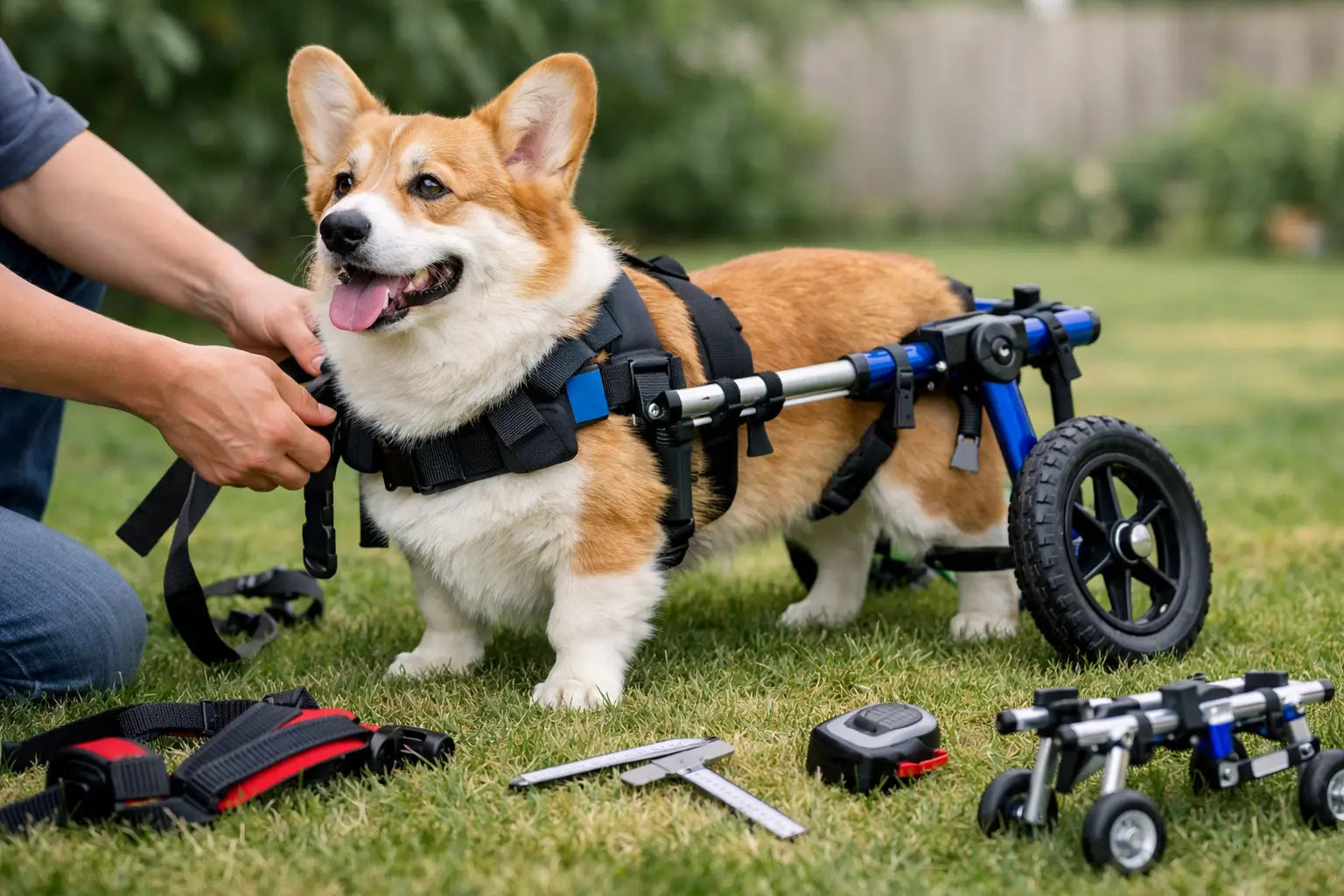
A well-fitted rear wheelchair supports the pelvis in a neutral, comfortable position. Your dog should be able to put their front paws flat on the ground and take an even, purposeful stride. The back should not be sharply arched, sagging, or twisted to one side.
The frame should sit parallel to the body, with similar clearance on both sides. Harnesses and saddle supports should be secure enough that the cart does not slip or rotate, but you should still be able to slide a finger beneath straps where appropriate. Check that the frame does not rub the inner thighs, underarms, ribs or genital area.
Your dog should also be able to toilet without the wheelchair obstructing them. This is a practical detail worth checking before your first proper walk. Some dogs need a slight adjustment to the rear support or leg rings to find a position that works comfortably.
Signs the size or adjustment is wrong
A dog may need a period of conditioning, especially if they have been inactive or are rebuilding strength. But persistent discomfort is not something to work through. Stop and reassess if you notice rubbing, redness, hair loss, yelping, heavy panting unrelated to weather, reluctance to move, or repeated attempts to sit or lie down while in the cart.
Watch the movement pattern too. Knuckling at the front paws, dragging the rear feet more than expected, hopping unevenly, scuffing one wheel, or leaning heavily to one side can indicate an adjustment issue. It can also signal pain, fatigue or progression in the underlying condition, so do not assume the wheelchair is the only cause.
Check the skin after every early session. Pressure areas can develop quickly, especially on thin-coated, senior or underweight dogs. A supportive harness, soft padding and the ability to fine-tune the frame are not luxuries: they are central to comfortable, dignified mobility.
Measure for the dog you have today
It is tempting to buy a wheelchair based on breed examples, especially when you see a similar-looking dog in a product photograph. Breed is only a starting point. Two Cockapoos, Labradors or French Bulldogs of the same weight can have very different leg lengths, chest shapes and pelvic widths.
If your dog is young, still growing, losing weight during recovery or gaining condition after reduced activity, an adjustable model may offer better value than a fixed frame. Adjustment has limits, though. A frame that is adjusted to its absolute maximum or minimum may not give the same stable fit as the size designed for that body range.
For a dog recovering from surgery, ask the clinical team whether weight-bearing is encouraged and for how long. Some dogs need supported standing and short, controlled outings; others need a cart that allows regular exercise without overdoing it. The goal is not simply to get moving. It is to build confidence and preserve comfort while protecting recovery.
Make the first outings easy
Choose smooth, quiet ground for the first few trips: a patio, level garden path or familiar pavement is kinder than deep grass, gravel or a steep hill. Bring water, take frequent breaks and keep the first walk shorter than you think. Your dog may be thrilled by their new freedom and tire before they show it.
A wheelchair is a mobility aid, not a replacement for supervision. Avoid leaving your dog in it unattended, and remove it for rest unless your veterinary professional has given different guidance. Wipe down wheels and check fastenings after muddy walks, particularly in wet British weather.
The best fit is the one that lets your dog move with comfort, confidence and their usual curiosity. Take your measurements carefully, ask for specialist guidance when you are unsure, and give your dog time to rediscover that the adventure is still theirs to enjoy.