Choosing the Right Cat Carrier for Car Travel
A cat carrier for car travel is not simply a box to get from A to B. It is your cat’s safe, familiar space while the car changes speed, turns corners and fills with unfamiliar sounds. The right choice can reduce stress for a reluctant passenger and make a routine vet visit, a move or a family holiday far more manageable for everyone.
Cats rarely enjoy being confined because we ask them to. They cope better when the carrier is comfortable, predictable and properly secured. That is why the best option is not always the prettiest one, the largest one or the carrier labelled for the longest list of uses. It needs to suit your cat, your vehicle and the journeys you actually make.
What makes a safe cat carrier for car travel?
For car journeys, containment and restraint work together. A carrier keeps your cat from getting under pedals, climbing around the cabin or escaping when a door opens. Securing that carrier helps prevent it sliding, tipping or becoming unstable when you brake.
Choose a carrier with a solid, reliable closure that your cat cannot push open from inside. Zips should have sturdy pullers and, on soft carriers, ideally a clip or fastening that stops an inquisitive paw working the zip loose. Hard-sided carriers should have a door that latches positively rather than relying on a flimsy plastic catch.
Ventilation matters just as much. Your cat should have airflow from more than one side, without such large openings that they feel exposed. Mesh panels are useful in a fabric carrier, provided they are strong, securely stitched and not easily clawed through. Never cover every vent with a blanket, particularly in warm weather. A light cover over part of the carrier can create a welcome visual refuge, but air must continue to circulate freely.
For travel by car, do not hold a carrier on your lap. Position it in accordance with both the carrier and vehicle manufacturer’s instructions, using a suitable seatbelt-routing system or other approved restraint where provided. Many carriers are designed to sit securely on the rear seat; others may be more stable on the rear footwell, depending on their shape and your car. The front passenger seat is a poor choice because of the airbag. The key is that the carrier stays level, cannot move around and remains well ventilated.
Hard carrier or soft carrier?
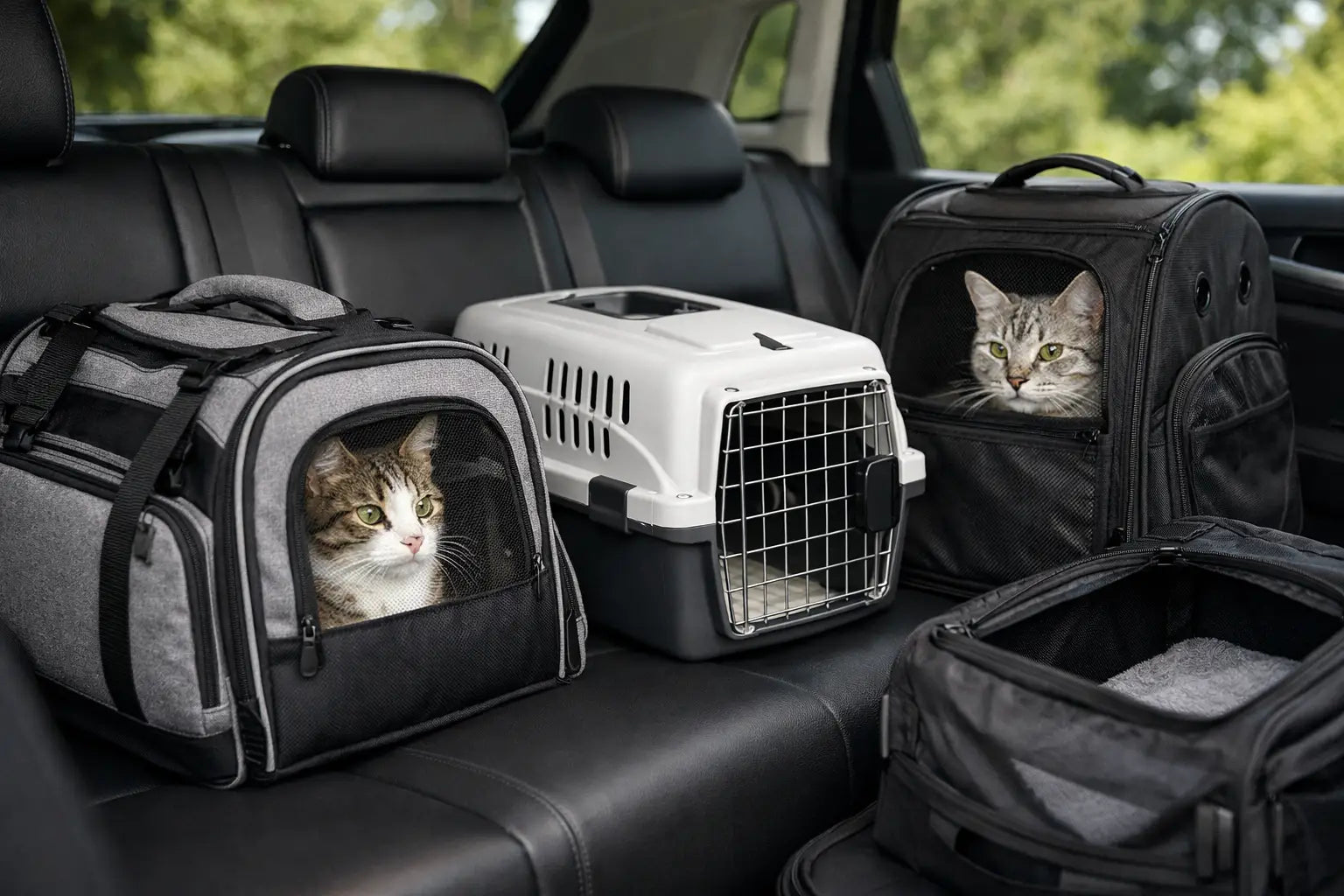
There is no universal winner. A hard plastic carrier is often the sensible choice for cats who are nervous, prone to toileting during travel or likely to scratch and chew when unsettled. It is easy to wipe clean, keeps its shape if the car journey is bumpy and usually offers better protection from knocks. A top-opening model can also make it less stressful to lift a reluctant cat out at the vet, rather than tipping them through a front door.
A premium soft-sided carrier can be lighter to carry, kinder on a cat’s body if they need to be lifted over a longer distance and easier to store at home. It may suit a calm cat travelling in a smaller car, especially when it has a reinforced base, structured sides and generous mesh ventilation. Some models are designed for both vehicle use and airline travel, though airline approval always depends on the individual airline’s current dimensions and rules.
The trade-off is structure. A soft carrier that sags, collapses or has an unprotected mesh door is not a good car-travel carrier for an anxious cat. Look for a firm base, quality stitching, stable handles and clear guidance on how it can be secured in the vehicle.
Get the size right, not simply bigger
Your cat needs enough room to stand, turn around and lie down naturally. They should not be pressed against the roof or forced to curl into an awkward position. At the same time, an oversized carrier can allow them to slide from side to side when the car moves, which is unsettling and potentially uncomfortable.
Measure your cat while standing: length from nose to base of tail, height from floor to the top of the head or ears, and their weight. Use the manufacturer’s internal dimensions and stated weight limit, rather than judging by a product photograph or breed label alone. A large Maine Coon and a compact British Shorthair may both be described as large cats, yet need very different space.
If you travel with two cats, give each cat their own carrier unless they are genuinely bonded, relaxed in close quarters and the carrier is specifically sized and rated for their combined weight. Even friendly cats can become frightened or fractious during a journey. Separate carriers also make it safer to manage each cat when you arrive.
Comfort is a practical safety feature
A carrier that feels slippery, cold or unfamiliar is harder for a cat to tolerate. Add a fitted fleece liner, thin vet bedding or an absorbent pad that sits flat and will not bunch beneath their paws. For a cat who gets travel sick or urinates through fear, layer an absorbent pad beneath a washable cover and take a spare set in the car.
Avoid leaving a loose collar, lead or harness attached inside the carrier. These can snag on vents or fittings when a cat changes position. If your cat wears a harness for safe transfers, put it on before you leave home, then attach a lead only once the carrier is securely closed or you are in a safe, enclosed space.
Temperature deserves attention, particularly during British summer heatwaves and winter cold snaps. Cars warm up and cool down quickly. Keep the carrier away from direct sun where possible, use the vehicle’s ventilation thoughtfully and never leave your cat unattended in a parked car. Even a short stop can become dangerous when the temperature rises.
Help your cat learn that the carrier is not a warning sign
The most thoughtfully engineered carrier cannot do all the work if it appears only moments before a vet appointment. Leave it open at home with familiar bedding inside, in a quiet spot your cat already likes. Place treats near the entrance first, then further inside as their confidence grows. Let them choose to investigate.
Once they are comfortable resting in it, practise closing the door for a few seconds while offering a treat, then open it before they become distressed. Build gradually to lifting the carrier, walking around the house and sitting in the parked car. A short drive around the block can be a better lesson than making their first journey a two-hour motorway trip.
Keep the car calm. Speak quietly, avoid loud music and resist opening the carrier to reassure them at traffic lights. A frightened cat can bolt through the smallest gap. If your cat yowls, pants, drools heavily or becomes distressed on every trip, speak to your vet before a longer journey. They can rule out pain, motion sickness and medical causes, and advise on appropriate support.
Details worth checking before you buy
Premium carriers often justify their price through the details that matter after the first use: reinforced base panels, washable liners, lockable zips, durable mesh, multiple access points and clearly specified vehicle compatibility. If a carrier is marketed as crash-tested or designed for car restraint, check exactly what that claim covers. Testing standards, tested weight ranges and installation methods vary, so a label alone should not be treated as a guarantee for every cat, carrier and vehicle combination.
Think about your own handling too. A carrier may be perfect for your cat but awkward if you live in a top-floor flat, have limited boot space or need to carry it from a distant car park. Padded handles, a shoulder strap used only when appropriate, and a design that stays level while lifted can make a real difference.
At Pets Own Us, the focus is on travel equipment that lets pets remain part of the plan without asking them to compromise on comfort or dignity. For your cat, the best carrier is the one that feels secure at home, stable in the car and easy for you to use correctly every time.
Before the next journey, set the carrier out with their familiar bedding and let curiosity do the first bit of travelling. A calm association built in the living room often begins long before the engine starts.